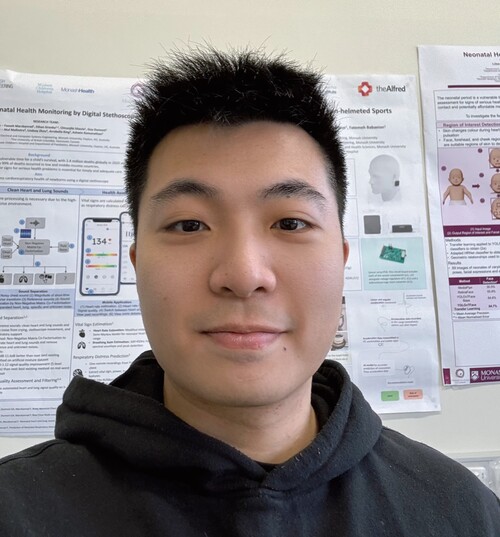
| 唐惟韬 | 莫纳什大学人工智能与医疗技术博士在读 |
Welcome! 👋
I am a Ph.D. candidate specializing in Artificial Intelligence in Medical Technology at the Department of Electrical and Computer Systems Engineering, Monash University, Australia. Prior to my doctoral journey, I earned a Master of Data Science from Monash University (focusing on Educational Data Mining) and a Bachelor of Science (Honours) in Computer Science from the University of Nottingham Ningbo China (UNNC), specializing in Computer Vision.
My doctoral research bridges advanced machine learning and perinatal medicine. I focus on biomedical time-series analysis, deep transfer learning, and domain adaptation, specifically processing multimodal signals—such as fetal Electroencephalogram (EEG) 🧠, Electrocardiogram (ECG) 🫀, and Electromyography (EMG) 💪—for automated sleep state classification 💤 and hypoxia–ischemia detection ⚠️.
🎓 Funding & Support: My research is fully supported by the Faculty of Engineering International Postgraduate Research Scholarship (FEIPRS) and the Ex Animo Scholarship for Engineering (EASE), with an additional research top-up funded by the U.S. National Institutes of Health (NIH).
He works collaboratively across several institutions, including Emory University and the Georgia Institute of Technology, and is jointly supervised by:
- Assoc. Prof. Faezeh Marzbanrad — Monash University
- Dr. Robert Galinsky — Hudson Institute of Medical Research & Monash University
- Prof. Gari D. Clifford — Emory University & Georgia Institute of Technology
- Dr. Nasim Katebi — Emory University
Together, this multidisciplinary team aims to advance AI-driven physiological monitoring, fetal neurodevelopment assessment, and early diagnosis in perinatal medicine.
🔬 Research Interests
💤 Adult, neonatal and fetal sleep state classification
Using deep learning for automated identification of adult, neonatal and fetal behavioral states.🧠 Multimodal physiological signal analysis
EEG, ECG, EMG, and heart rate variability for comprehensive fetal monitoring.🔁 Transfer learning & cross-species/domain adaptation
Improving generalization between adult-neonatal-fetal datasets and across species.🩺 Fetal hypoxia–ischemia detection
Early prediction of neurodevelopmental risk from physiological signals.🤖 Trustworthy & interpretable AI for perinatal care
Model robustness, transparency, and clinical decision support.📈 Representation learning for biomedical time-series
CNNs, RNNs, Transformers, contrastive learning, and latent space modeling.
🔥 News
🎓 Ph.D. Research: AI & Fetal Monitoring (2024 – Present)
Focus: AI-driven Fetal Sleep Analysis, Hypoxia Detection & Physiological Sensing
📝 2026 — Paper Published, IEEE Journal of Biomedical Health Informatics (JBHI) “FetalSleepNet: A Transfer Learning Framework with Spectral Equalisation Domain Adaptation for Fetal Sleep Stage Classification” (SCI, JCR Q1, IF = 7.7, 医学1区TOP)
💤 2026 — Paper Published, Sleep (Oxford University Press)
“Fetal Sleep: A Cross-Species Review of Physiology, Measurement, and Classification” (SCI, JCR Q1, IF = 7.0, Top-tier Sleep Medicine Journal, 医学2区TOP)🇺🇸 2025 — Visiting Scholar, Emory University & Georgia Institute of Technology, USA
Collaborating on advanced fetal EEG–ECG–EMG research.🇺🇸 2025 — 1-Page Abstract Accepted, IEEE-EMBS International Conference on Biomedical and Health Informatics (BHI’25), (Atlanta, USA)
“Fetal Sleep State Classification Using Deep Learning.”🔬 2024 — Paper Published, IEEE Sensors 2024 (Kobe, Japan)
“Advancing Fetal Surveillance with Physiological Sensing: Detecting Hypoxia in Fetal Sheep”🤝 2024 — Joined Fetal Research Program, Emory × Georgia Tech Supervised by Assoc. Prof. F. Marzbanrad, Dr. R. Galinsky, Prof. G. Clifford, and Dr. N. Katebi.
🎓 Master’s Research: AI & Education (Prior to 2024)
Focus: Contrastive Learning, Graph Embedding & Educational Data Mining
🧠 2025 — Paper Published, Neural Networks “Contrastive Graph Auto-Encoder for Graph Embedding” (SCI, JCR Q1, IF = 7.2, 计算机科学2区TOP) — Note: Result of Master’s research.
🎤 2024 — Paper Published, IEEE ICASSP 2024 (Seoul, Korea)
“GuessKT: Improving Knowledge Tracing via Guess Behaviors”⚖️ 2024 — arXiv Preprint, Computer Science (Edu) “Fair Knowledge Tracing in Second Language Acquisition” Investigated algorithmic fairness across platforms (iOS/Android) and regions (Developed vs. Developing countries) using Duolingo datasets. [arXiv:2412.18048]
🎖️ Honors & Awards
🌟 2025 — NextGen Scholar Award (NSF–EMBS–Google Sponsored) Selected as a global recipient of the “Next-Generation Young Scholar” program at IEEE BHI 2025. This prestigious award is jointly sponsored by the U.S. National Science Foundation (NSF), the IEEE Engineering in Medicine and Biology Society (EMBS), and Google, recognizing outstanding early-career researchers with the potential to lead future innovations in biomedical informatics.
🏅 2025 — Best Poster Award, IEEE BHI 2025 (Atlanta, USA)
Recognized by the conference committee for the work: “Fetal Sleep Stage Classification Using Deep Learning,” selected for its technical excellence and impact on fetal health monitoring.
📸 View Photos from the Conference
| | |
- 🇦🇺 2023 — Stephen FitzGerald Scholar
I was selected as one of the national recipients of the prestigious Stephen FitzGerald Scholars Program, funded by the National Foundation for Australia–China Relations (an initiative of the Australian Department of Foreign Affairs and Trade).
🤝 Academic Services
- Program Committee (PC) Member
- IEEE International Conference on Adaptive Intelligence, Modeling and Simulation (ICAIMS) 2026
- Peer Reviewer
- IEEE Journal of Biomedical and Health Informatics (JBHI)
- Scientific Reports
- Computing in Cardiology (CinC) Conference
- IEEE International Conference on Adaptive Intelligence, Modeling and Simulation (ICAIMS) 2026
📬 Contact
Feel free to reach out for academic collaborations, research discussions, or professional opportunities:
- Monash University: Weitao.Tang1@monash.edu
- Emory University: WTANG31@emory.edu
- Personal: weitaotang340@gmail.com